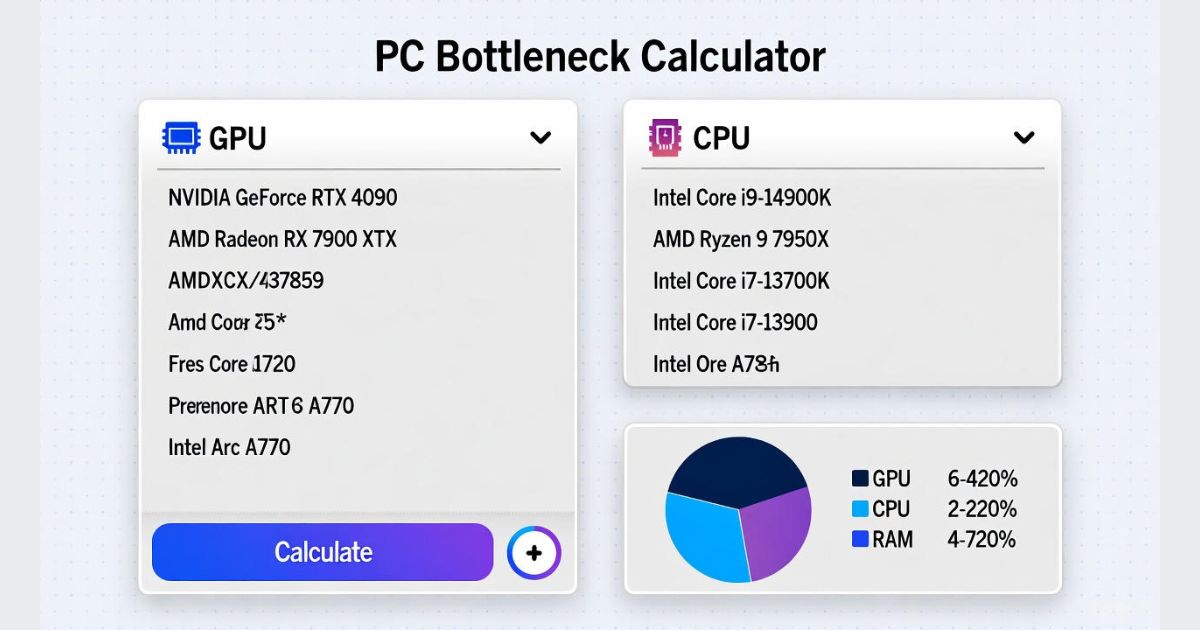
PC Bottleneck Calculator
Analyze your PC build for performance imbalances between CPU and GPU. Get detailed insights, recommendations, and optimization tips for gaming, productivity, and more.
Build Configuration
Analysis Results
Bottleneck Percentage
0%
Performance Balance
Estimated FPS
N/A
In popular titles at selected resolution and refresh rate.
Power & Thermal Estimate
Total System Power: N/A W
Recommended PSU: N/A W
Recommendations
Detailed Breakdown
| Component | Performance Score | Adjusted Score | Notes |
|---|
Ultimate Guide to the PC Bottleneck Calculator
Hey there, fellow tech enthusiast! Ever built your dream PC only to watch it chug along like a snail during your favorite game? Or maybe you’re upgrading components and wondering if they’ll play nice together.
If that sounds familiar, you’re not alone. I’ve been there—staring at my screen, frame rates dipping, and scratching my head over why my shiny new GPU isn’t living up to the hype. The culprit? A sneaky little thing called a “bottleneck.”
In this post, we’re diving deep into the world of the bottleneck calculator. We’ll break it down simply, no jargon overload, and show you how these handy tools can save your build from frustration.
Whether you’re a casual gamer or a serious PC tinkerer, understanding how to calculate bottleneck issues will keep your rig humming happily. Stick around—we’ve got tips, tools, and even a few laughs along the way.
What Exactly Is a Bottleneck in Your PC?
Picture this: Your PC is like a busy kitchen during dinner rush. The chef (your CPU) is chopping veggies like a pro, but the oven (your GPU) is waiting forever for ingredients. That’s a bottleneck—when one part of your system holds back the others, slowing everything down.
In tech terms, a PC bottleneck happens when your hardware components don’t match up well. Your CPU bottleneck calculator might reveal that your processor is too weak for your powerhouse graphics card, causing lag in games or sluggish video edits. On the flip side, a GPU bottleneck calculator could show your graphics card is starved because the CPU can’t feed it data fast enough.
Bottlenecks aren’t just about CPU and GPU. They can sneak into RAM, storage, or even your motherboard. But don’t worry—tools like the computer bottleneck calculator make spotting them a breeze. Think of it as a health check for your PC’s heart and lungs.
Why does this matter? A balanced build means buttery-smooth performance, longer hardware life, and fewer headaches. I’ve wasted bucks on mismatched parts before; learning about bottlenecks early would’ve saved me a ton.
Why Bother with a Bottleneck Calculator?
Building or upgrading a PC is exciting, but it’s also a puzzle. Without the right tools, you might end up with a lopsided setup that underperforms. Enter the bottleneck calculator—your digital sidekick for smart decisions.
These calculators crunch numbers based on your specs: CPU model, GPU, RAM speed, resolution, and usage (like gaming or content creation). In seconds, they spit out a percentage showing the bottleneck severity. A 10% mismatch? No biggie. Over 15%? Time to rethink.
For gamers, a gaming bottleneck calculator is gold. It predicts FPS drops in titles like Cyberpunk 2077 or Fortnite. Professionals love the CPU GPU bottleneck calculator for ensuring workflows fly without hiccups.
And let’s be real: Trial-and-error fixes are pricey and time-sucking. A quick bottleneck calculation upfront? Priceless. Plus, with free online options, there’s zero barrier to entry.
Types of Bottleneck Calculators: Finding the Right Fit
Not all bottleneck calculators are created equal. Some focus on specifics, while others give the full picture. Here’s a quick rundown to help you choose.
CPU-Focused Tools
If your processor feels like the weak link, grab a CPU bottleneck calculator. These zoom in on how your brainy chip handles tasks. Great for multitasking monsters or older Intel/AMD setups.
GPU-Centric Calculators
Struggling with visuals? A GPU bottleneck calculator checks if your graphics card is twiddling its thumbs. Ideal for high-res gamers eyeing 4K bliss.
All-in-One Wonders
The CPU and GPU bottleneck calculator is the Swiss Army knife here. It balances both powerhouses, factoring in real-world scenarios. For comprehensive checks, this is your go-to.
Niche Calculators for Storage and More
Don’t forget the unsung heroes:
- RAM bottleneck calculator: Spots if your memory is choking data flow.
- SSD bottleneck calculator: Ensures your speedy drive isn’t waiting on slow buses.
| Type | Best For | Example Use Case |
|---|---|---|
| CPU Bottleneck Calculator | Processor-heavy tasks | Video rendering on a budget build |
| GPU Bottleneck Calculator | Graphics-intensive games | 1440p gaming at high frames |
| CPU & GPU Bottleneck Calculator | Overall balance | Streaming while playing |
| RAM Bottleneck Calculator | Multitasking | Browser tabs + Photoshop |
| SSD Bottleneck Calculator | File transfers | Large game installs |
Pro tip: Always cross-check with a trusted bottleneck calculator from reputable sites. User reviews and update dates matter—tech evolves fast!
How to Use a Bottleneck Calculator: Step-by-Step
Ready to roll? Using a calculate bottleneck tool is easier than assembling IKEA furniture (minus the missing screws). Here’s your no-fuss guide.
- Gather Your Specs: Jot down your CPU (e.g., Intel i5-12400), GPU (RTX 3060), RAM (16GB DDR4), and resolution (1080p). Tools like CPU-Z can help if you’re fuzzy on details.
- Pick Your Tool: Head to a site with a best bottleneck calculator. Free ones like PC-Builds or BottleneckCalc work wonders.
- Input the Data: Plug in your components. Select usage—gaming? Productivity? Some even let you tweak overclocks.
- Hit Calculate: Boom! Results pop up with a bottleneck percentage. Green? You’re golden. Yellow? Minor tweak needed. Red? Swap time.
- Interpret and Act: A game bottleneck calculator might say your CPU is bottlenecking by 20% in Valorant. Solution? Upgrade or lower settings.
I’ve run these on my rig before a big upgrade. Saved me from buying a GPU that my old CPU couldn’t feed—disaster averted!
For fun, try simulating wild combos. What if you pair a beastly AMD Ryzen 9 with a potato-era GPU? The calculator’s warnings are hilariously spot-on.
Spotlight on the Best Bottleneck Calculators
With so many options, which bottleneck calculator for games reigns supreme? I scoured forums and tested a bunch. Here’s my top picks, ranked for ease and accuracy.
1. PC-Builds Bottleneck Calculator (The Trusted Go-To)
- Why It Rocks: Super intuitive, covers CPU, GPU, and even RAM. Updated for 2025 hardware.
- Pros: Free, mobile-friendly, detailed breakdowns.
- Cons: No SSD focus.
- Best For: Beginners wanting a trusted bottleneck calculator.
2. CPUAgent Bottleneck Tool (AMD and Intel Lovers Unite)
- AMD Bottleneck Calculator mode shines for Ryzen fans, while Intel Bottleneck Calculator nails Core i-series quirks.
- Pros: Brand-specific tweaks, exportable reports.
- Cons: Slightly clunky interface.
- Best For: Tailored advice on your fave chipmaker.
3. Game-Debate Bottleneck Checker (Gamer’s Delight)
- This gaming bottleneck calculator simulates in-game performance. Enter your setup, pick a title, and see FPS estimates.
- Pros: Game database is massive—over 50,000 titles.
- Cons: Ads can annoy.
- Best For: Esports pros chasing 240Hz glory.
Quick Comparison Table
| Calculator | Key Feature | Free? | Mobile App? |
|---|---|---|---|
| PC-Builds | Full system scan | Yes | No |
| CPUAgent | Brand-specific | Yes | Yes |
| Game-Debate | Game FPS predictions | Yes | No |
| Calc.Bottleneck | RAM/SSD integration | Freemium | Yes |
Whichever you choose, aim for one that’s current. Outdated databases lead to wonky bottleneck calculation results.
Common Bottlenecks and How to Fix Them
Bottlenecks love hiding in plain sight. Let’s troubleshoot the big ones with your computer bottleneck calculator in hand.
The CPU Bottleneck: When Brains Lag
Your processor is multitasking’s MVP, but pair it with a monster GPU, and it’ll gasp for air. Signs? Stuttering in CPU-bound games like strategy sims.
- Fixes:
- Upgrade to a newer gen (e.g., from Intel 10th to 14th).
- Overclock if you’re adventurous (use with cooling!).
- Close background apps—those Chrome tabs are thieves.
A CPU bottleneck calculator often flags this at 1080p resolutions, where CPU grunt matters most.
GPU Bottlenecks: Starved for Pixels
At higher resolutions like 4K, your graphics card shines—unless the CPU starves it. Result? Beautiful scenes at half speed.
- Fixes:
- Match GPU power to CPU (e.g., no GTX 1050 with Ryzen 7).
- Enable Resizable BAR in BIOS for better data flow.
- Drop settings temporarily while you save for an upgrade.
Tools like the CPU GPU bottleneck calculator highlight this mismatch perfectly.
RAM and Storage Sneak Attacks
Slow RAM? Your system swaps to disk, killing speed. Ditto for HDDs vs. SSDs.
- RAM Tips: Aim for 3200MHz+; use a RAM bottleneck calculator to check.
- SSD Savvy: NVMe drives rule; a SSD bottleneck calculator ensures your PCIe lanes aren’t clogged.
| Bottleneck Type | Symptoms | Quick Fix |
|---|---|---|
| CPU | Low FPS in menus | Faster processor |
| GPU | High usage but low output | Better CPU pairing |
| RAM | Hiccups in open-world games | 32GB upgrade |
| SSD | Long load times | Switch to NVMe |
Real talk: I once ran a bottleneck calculator for games on my setup and found RAM was the villain. A cheap upgrade? Night-and-day difference.
Tailoring for AMD vs. Intel: Brand-Specific Insights
AMD and Intel fans, this one’s for you. Each has strengths, but mismatches bite harder.
AMD Bottleneck Calculator: Ryzen’s Multi-Core Magic
Ryzen CPUs crush threads, but older ones bottleneck high-end GPUs in single-thread tasks like older games.
- Sweet Spot: Pair Ryzen 5 7600 with RTX 4070 for balanced bliss.
- Watch Out: Budget AM4 boards limit overclocks.
Intel Bottleneck Calculator: Core i-Series Speed Demons
Intel excels in single-core zip, but high power draw can thermal-throttle.
- Sweet Spot: i7-13700K with RX 7800 XT—gaming heaven.
- Watch Out: LGA 1700 socket future-proofs better.
Use a dedicated AMD bottleneck calculator or Intel bottleneck calculator to simulate. Forums swear by these for avoiding “what if” regrets.
Gaming Deep Dive: Bottlenecks in Your Favorite Titles
Gamers, rejoice—or prepare to optimize. A game bottleneck calculator isn’t just theory; it’s your FPS savior.
In fast-paced shooters like Apex Legends, CPU bottlenecks kill peeker’s advantage. Strategy epics like Civilization? GPU waits on CPU turns.
- Pro Hacks:
- Test at native res—upscaling hides issues.
- Monitor with MSI Afterburner during play.
- Use V-Sync sparingly; it masks but doesn’t fix.
I’ve crunched numbers on my rig for Elden Ring. The calc predicted a 12% CPU hitch—lowered shadows, gained 20 FPS. Magic!
For esports? Zero tolerance. A solid gaming bottleneck calculator ensures your setup dominates.
Beyond Basics: Advanced Bottleneck Tips
Once basics click, level up. Consider:
- Overclocking Impact: Calcs often ignore this—test post-OC.
- Cooling’s Role: Hot components bottleneck via throttling.
- Software Tweaks: Update drivers; Windows bloatware loves to hog resources.
Pair with benchmarks like Cinebench for validation. Your best bottleneck calculator + real tests = unbeatable combo.
FAQs About PC Bottleneck Calculator
Q. What’s the ideal bottleneck percentage?
Aim under 10% for smooth sailing. Anything 15%+ screams “upgrade me!” Most PC bottleneck calculators color-code this for easy reading.
Q. Can bottlenecks affect non-gaming tasks?
Absolutely! Video editing or 3D rendering hits CPU walls hard. A CPU and GPU bottleneck calculator covers creative workflows too.
Q. Are bottleneck calculators 100% accurate?
They’re estimates based on averages—real life varies with settings and temps. Use as a guide, not gospel, and back with benchmarks.
Q. How often should I run a bottleneck check?
After upgrades, new games, or if performance dips. A quick calculate bottleneck session keeps things fresh.
Conclusion
There you have it, your roadmap to bottleneck-free bliss. From spotting that pesky CPU drag to fine-tuning for AMD glory, a reliable bottleneck calculator is every builder’s best friend. Next time you’re eyeing parts, fire one up.
Disclaimer: This guide is for informational purposes only. Hardware performance varies by setup and usage. Always consult official specs and test your own rig for best results.